Rope Compass for Bottoming
Version 1.0
2026 Apr 6
Introduction
For many years there has been a tangible gap in rope education between riggers and models. This has improved over time, with many educators including both tops and bottoms in their classes, as well as dedicated bottoming classes, but the difference is still present in terms of knowledge, number of classes, and general discourse.
In 2024 it came to my mind that education for tops and education for bottoms have an inherent structural difference: learning how to tie is tangible while learning how to get tied is intangible. Tying by nature is grounded in visible knots and patterns. It’s absolutely much more than that, yet that very visible component helps setting a baseline to anchor other topics. Other disciplines have a similar problem, where the superficial part is picked up easily and often it’s perceived to be “all” there is about the discipline: think for instance how many martial arts have deep philosophies and are seen as just the fighting part, or how design is much more complex than just pretty shapes. The way has been historically approached in many of these cases is by providing mental models that help people anchor the intangible.
This work is one way to provide that anchor for rope bottoming.
Who is this for
The most important group for this is new rope bottoms. These are key skills and concepts that allow new people to identify what is important to know, what kind of classes and teachers to look for, and what areas are worth looking into.
A second group is educators. As this material is created to help and support learning, educators can use it to map their own work, sharpen and deepen their classes, and expand on this compass as needed. I want to stress this isn’t an all comprehensive list of skills, it’s meant to be taken and be made yours.
This is for all bottoms. This compass will hopefully provide a shared language everyone can use to refer to different parts of the bottoming experience, and help conversations to happen in a more structured way.
Finally, this is for everyone, riggers included, to help create a shared language that elevates conversations and promotes learning.
A note on language
I want to acknowledge language can be complex: different scenes have different definitions for similar things, and different individuals might use terms in different ways — all while sharing a common core of understanding.
Here I will be using the pairs rope top/rigger and bottom/model/bunny as roughly equivalent terms, unless differently stated. With full acknowledgement this isn’t fully accurate, as each term has different connotations, I opted to use them interchangeably. This is because these distinctions aren’t the goal of this writing, and equally there isn’t a distinct consensus across scenes and individuals on the various terms. Rather than picking one and alienating everyone that doesn’t appreciate that choice, I opted to be annoying to everyone equally.
Picking the terms to use for each of the skills has also been a challenge, and took many months of work discussing with a lot of people. I invite to use them always paired with their longer definition.
A note on inclusion
While I can’t be sure I achieved it in full, I put a lot of work into trying to make the compass and explanations more effective across different dimensions of diversity. This was done not just by bringing in my own experience and researching, but also talking to people to review and have different perspectives.
Generally speaking, the guidance should always be intended in the most comprehensive and intersectional way possible. Wherever it falls short, I’ll work to improve it.
Compass overview
The rope compass for bottoming is an open model that provides a shared language for bottoms and educators to discuss, learn, and structure the skills needed in each personal rope journey.
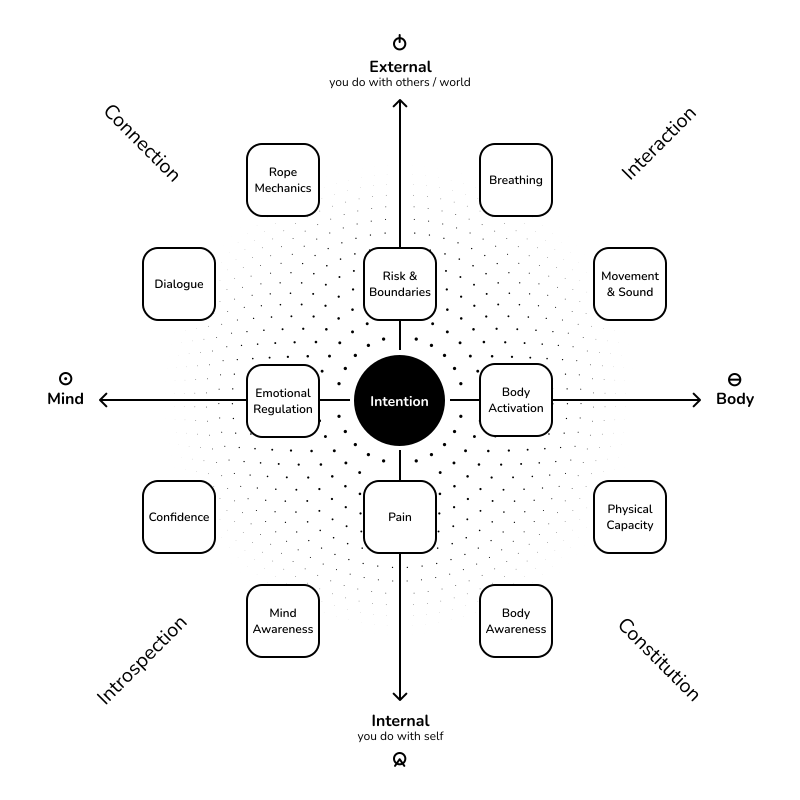
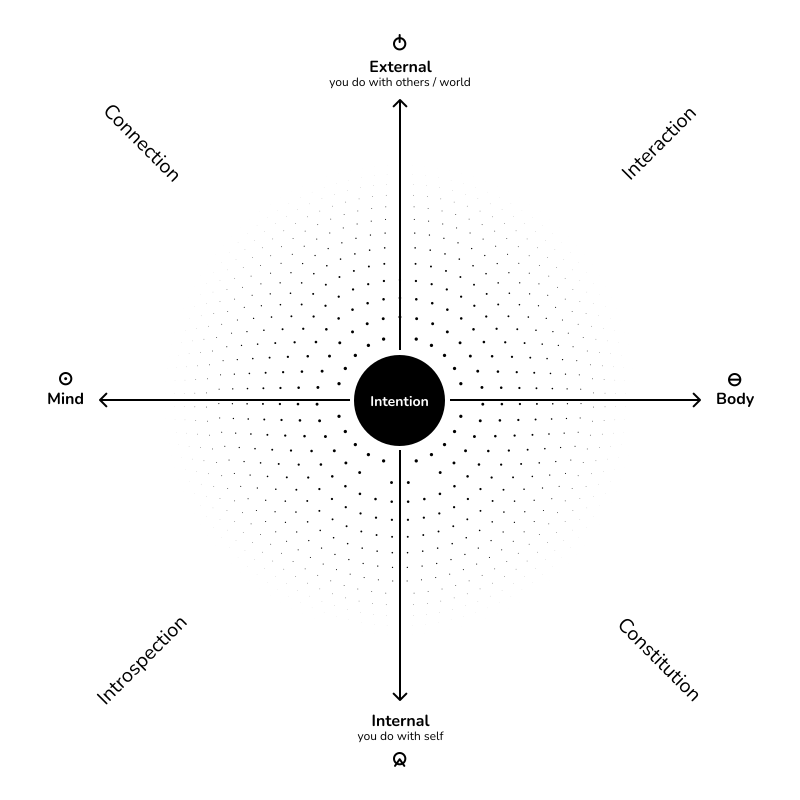
There are two axes to help place the various skills in a way that is easier to reference and recognise: External and Internal, Mind and Body.
External identifies skills that are more directly involved in interacting and being in the world and with the other people. On the other side, Internal is about skills that are between us and ourselves, and while they can influence the external world, are primarily explored with personal practice.
Body identifies skills that are about the physical component, muscles, movement, and everything our body does. On the other side, Mind is about skills that are cognitive, including rational and irrational, thinking and emotion.
These axes and the four quadrants are not to be considered absolute, or pure: as many things regarding humans, these are spectrums and each interacts and contributes to every skill in different proportions. The placement of the skills also has made tradeoffs for clarity and educational purposes: while the general placement is relevant, the exact position shouldn’t be taken too strictly. For example, the Breathing skill also has an Internal and a Mind component.
The combination of each creates four different quadrants, named for ease of reference:
- Connection labels the quadrant of Mind and External.
- Introspection labels the quadrant of Mind and Internal.
- Interaction labels the quadrant of Body and External.
- Constitution labels the quadrant of Body and Internal.
The names of the quadrants have been carefully selected to help understand the general direction that is identified within them. When we refer to our mind looking toward the external reality, we create Connection with the space and others. The Interaction of the body with the outer world defines the skills in that quadrant. In the inner world, our mind, with thought and emotion, is the domain of Introspection, while we also acknowledge the importance of the body and its Constitution.
Intention is at its core
Learning skills is good, but if not driven by intent it becomes a mechanical endeavour. Yes we can learn all these skills to perfection, and then… what? If it’s not driven by our intent, this is not going to be very fulfilling, and depending on the person, might even get frustrating.
Putting Intent at the center doesn’t mean having all the answers. Especially at the beginning of any rope journey, it’s ok to not know clearly what we want to get out of rope. The important thing is to know there is an intent, somewhere, that we should interrogate us about. Sometimes it’s fine to be clear and driven, sometimes vague and open.
Also, it can change over time. Many expert rope bottoms and switches have evolved over the years. Maybe they started appreciating the physical sensation, then evolving in a personal challenge of mental and physical limits, and later becoming a meditative practice. As we change as individuals, our intent should follow.
Should we develop all these skills?
We should develop the skills that make the most sense to us. The reason why this has been developed as an open compass and not as a curriculum or a linear progression is that different people have different desires, come from different backgrounds, change over time, etc. This means that an individual will be focused on a set of them more than others, and that’s ok.
People have access to different teachers, and they themselves will have their own rope style that will be part of their classes. Recognising the style of the educator is also important as it allows us to make better decisions as we progress in our rope journeys, and possibly seek out different teachers later on.
Given the skills outlined in the compass have been selected to try to map all the most common ones, it’s also likely that in most rope bottoming journeys all of them will be learned and developed, at least to some extent.
Compass skills
The ‘skills’ here are defined as areas that cover both knowledge and practice. Sometimes they might lean more on the theoretical side, sometimes on the practical side. Each is centered on rope concepts that are containers for active, experimental practice, so they can be learned and developed over time.
This set of skills has been thoroughly researched across a wide group of people, yet it’s not meant to be exhaustive. The idea is to provide the key skills that cover most of the experience in rope for most bottoms, with full awareness that there’s more to it. The rest is left to individual rope journeys to discover, and to individual teachers to extend and complement.
The skills identified are:
- Rope Mechanics
- Dialogue
- Emotional Regulation
- Confidence
- Mind Awareness
- Pain
- Risk & Boundaries
- Breathing
- Movement & Sound
- Body Activation
- Body Awareness
- Physical Capacity
These skills might have overlapping areas, and in some cases the overlap is stronger: for example Breathing plays an important role in both Pain processing and Emotional Regulation. In these cases, there’s a note on these skills being related.
Some of the skills identified correspond to some more common concepts that are found in the general rope discourse among various communities. For example, “Body Activation” has a lot in common with what’s often called “Active Bottoming”. The compass avoids using these more common concepts to avoid misunderstandings due to existing definitions, and to be able to have skills that are broader in scope.
Rope Mechanics
Knowledge of the effect and use of different ties on the body. Experience in how ties affect the body, positions, and transitions.
This skill refers to what we study in more standard classes that teach pattern and rope technique. For bottoms, this doesn’t necessarily mean knowing how to tie — even if it might well be. The skill here is about understanding how rope works when it is being placed on the body, how patterns work, why they work, and how tension affects the outcomes. It includes the ability to predict how specific ties and transitions can make a tie feel more intense. This can extend beyond the body: how uplines can be tied safely or how to know if the suspension point is good.
⇄ Relates to: Risk & Boundaries.
Examples of what this skill includes:
- How to tie a TK rope pattern, and what are the key elements that make it safe for suspension.
- How suspension harnesses work, and what makes them suspendable How suspension lines work and how they are made safe.
- How different placement of futomomos work on our body.
Examples of how to learn and improve:
- Classes and workshops that teach patterns and rope structure.
- Learning how to self-tie. Lab sessions a rigger, focused on understanding the tie.
- Physics, specifically classical mechanics.
- Discuss adaptations of patterns for different bodies.
Dialogue
Experience in clear verbal and non verbal communication, how to listen, observe, give feedback, and negotiation.
This skill is about communication, and explicitly highlights that there are multiple people involved in the process. Before a tying session, this includes negotiation techniques, clarity, sharing boundaries and desires. During a session, this includes how we share how we are and how we feel status — or, intentionally, how we don’t — and how different kinds of communication can affect the scene and the dynamic. After a session, this covers the ability to both ask for, give, and receive feedback.
⇄ Relates to: Risk & Boundaries, Breathing.
Examples of what this skill includes:
- How to communicate non-verbally if something goes wrong.
- How to use voice to help create a particular headspace or mood.
- How silence and noises contribute to a scene, on both sides.
- How and when to give feedback effectively.
Examples of how to learn and improve:
- Active practice of communicating with the person we tie with.
- Watch sessions of others and observe their (non) verbal communication.
- Classes teaching rope negotiation.
Emotional Regulation
Experience in identifying, feeling, and processing emotions, the effects of different rope, and connection to the other.
This skill covers all the wide range of techniques that help deepen the understanding of emotional responses and how to manage them. This is a complex skill that connects mind and body, as emotions are both cognitive as well as embodied. It’s not just internal, as it’s also the understanding and practice of how our emotions affect the other people we play with, co-regulation and aftercare. This includes also discerning where it comes from: rope related, rigger related, trauma related, or simply how we are on a specific day.
Especially for emotions coming from trauma, this regulation also includes wider topics on how to avoid triggers or safely approach a more difficult space.
⇄ Relates to: Breathing, Confidence, Mind Awareness.
Examples of what this skill includes:
- How to manage (strong) emotions when they arise in a scene.
- How to name and identify different emotions, and the different nuances within the same emotion, and how they surface within the body.
- How emotions transmit and influence each other in a scene.
- How after a scene the emotions can create a longer-term impact.
Examples of how to learn and improve:
- Practice how to identify and label different emotions.
- Acquire different techniques to manage emotions, like reframing, grounding, breathing, etc.
- Practice how different emotions surface within the body.
- Expand the window of tolerance for more challenging emotions.
- Experiment with different kinds of self-care after a scene.
Confidence
Knowledge of desires, wants, and body. Experience in self-advocating and saying “no” even in challenging situations.
This skill pertains to the psychological preparedness to navigate the power dynamics, grounded in one’s own self-knowledge. It lies its foundation in the journey of understanding of our desires, and the ability to identify how they change as we grow and in the moment. It’s also defined by the clarity of the direction we take as bottoms. This form of self-assuredness on one side is what allows us to find the right people to tie with, and on the other side is what makes it easier to understand when a boundary is passed, to speak up, and say “no”.
⇄ Relates to: Emotional Regulation, Mind Awareness, Risk & Boundaries.
Examples of what this skill includes:
- How to articulate specific desires.
- How to know where a boundary is, and when it’s passed.
- How to advocate for ourselves before, during, and after a scene.
Examples of how to learn and improve:
- Practice rope with different people and styles to understand our preferences.
- Do a debriefing after a scene, to review what happened and practice explaining.
- Write and map our desires.
- Read stories and other people’s experiences. Yes, smut counts.
Mind Awareness
Knowledge of meditation techniques. Experience in meditative mental states and subspace, and how rope affects them.
This skill is the ability to track our internal mental state — primarily during a scene, but also before and after. It defines how well we can observe and keep track of the changes of our mental state, our thoughts, and how present or not present we are. It also helps identify when we are in subspace and how to immerse in it while being safe. We also improve our understanding of what triggers smaller and bigger drops, how to differentiate them from other variables that might affect that in our lives, and how to manage them. It’s also the ability to know how our thoughts affect our emotions, and the other way around. This can extend to include how emotions can evolve during the relationship with someone from first ties onwards, expectations and attachment.
⇄ Relates to: Emotional Regulation, Confidence.
Examples of what this skill includes:
- How to identify different thought patterns and mental states.
- How to keep observing our mind as our mental states change and evolve during a scene.
- How to use emotional regulation at the right moment.
- How to hold two (or more) conflicting emotions.
Examples of how to learn and improve:
- Practice of meditation techniques.
- Post-scene journaling.
- Sensory deprivation labbing.
- Learn about flow states, and altered mental states.
Pain
Knowledge of pain types, meaning, and effects. Experience in processing both physical and psychological pain.
This skill explores the nature of pain across all its facets. The knowledge of what pain is, how it works within our bodies, and what it means. The experience of how it feels, across the many kinds of pain. The ability to process it and how it impacts our brain space and emotional response. It also includes how to differentiate between good and bad types of pain. It also includes psychological forms of pain: struggle, helplessness, exposure. It can also relate to existing trauma and how to navigate it during a scene. For people that have menstrual cycles, it’s also important to explore how this affects pain tolerance.
⇄ Relates to: Risk & Boundaries, Breathing.
Examples of what this skill includes:
- How to differentiate good and bad pain.
- How to process pain.
- How to identify pain we want during a scene, pain we don’t want but it’s a good struggle, and pain to avoid.
- How to communicate precisely what kind of pain is being experienced.
Examples of how to learn and improve:
- Explore on our own or with others different kinds of pain.
- Incremental practice to identify limits, also on different days and over time.
- Practice leaning into the pain instead of rejecting it.
Risk & Boundaries
Knowledge of anatomy and the risks of rope techniques. Experience in consent, assessing risks, and asserting boundaries.
This skill wraps all the various threads around understanding the risks of doing different types of rope, as well as articulating clearly our boundaries. It includes anatomical knowledge and the different kinds of issues that can arise, from nerve damage to blood, from muscular stress to psychological impact, from short term acute events to long term repeated strain.
⇄ Relates to: Dialogue, Confidence, Pain, Physical Capacity, Rope Mechanics.
Examples of what this skill includes:
- How to negotiate effectively.
- How to identify risk zones for nerve damage, both the theory and the specifics of our own body.
- How to check for nerve damage and blood restriction during a scene.
- How blood restriction can hide nerve damage.
- How to assert our boundaries.
- How to recognise power imbalance.
- How to assess how long one can last in a specific position, and communicate it.
Examples of how to learn and improve:
- Learn the Wheel of Consent by Betty Martin.
- Understand different models of consent, and how they apply in different spaces (kink, swinger, performances, etc).
- Study biology: muscles, nerves, and more.
- Map our boundaries.
- Simulate what to do if a boundary is bent or broken.
Breathing
Knowledge of different breathing techniques. Experience of breathing control and effects of rope on breathing.
This skill is a simple and intuitive one to start with, as it’s simply awareness and use of our own breathing. It then expands as a very powerful ability we can use in many ways, one of the most effective ones is pain and emotional regulation. From a technical side this is about exploring different breathing techniques, what works for us, and how we can use them effectively. It also includes how breathing is not just a regulation technique but it’s an element of how we communicate non verbally, and interact in a scene by aligning or de-synchronising breathing.
⇄ Relates to: Dialogue, Emotional Regulation, Pain.
Examples of what this skill includes:
- How different ties affect breathing, both physically and psychologically.
- How to breathe to process pain.
- How breathing is used to communicate in a scene. How to manage breathing restrictions.
- How breathing changes in inverted suspensions.
Examples of how to learn and improve:
- Explore different types of breathing techniques (chest, belly, back, etc).
- Practice meditations that include focus on breathing.
- Practice yoga.
- Experiment silent scenes with everyone involved focused on breathing.
Movement & Sound
Experience of movement and its reciprocal dynamic interaction, and sound: subtle movements, dancing, feral, noises, etc.
This skill encompasses the more dynamic side of rope. Movement takes different forms in different rope techniques and scenes: it can go from the more subtle, delicate, and minimal interaction, to wide transitions and fast paced changes that can even take the form of a dance with both parties moving in the space. Sound can follow a similar pattern, from the beauty of light whispers in a silent space to raw vocalizations and talks with a well rhythmed soundtrack. And of course, all the possible variations. Playfighting is also well represented within this skill.
⇄ Relates to: Body Activation, Body Awareness.
Examples of what this skill includes:
- How small shifts are used effectively to communicate.
- How to accompany rope in a dance-like movement safely.
- How to use sounds and music in a scene.
- How to talk in a way that is conducive to the scene we want.
Examples of how to learn and improve:
- Explore one of the many kinds of paired dances.
- Practice vocalising, making noises.
- Read smut to learn what to say, and practice to make sure it works as intended.
- Watch others to see their movements when tied, especially minimal ones.
- Practice in a quiet room paying attention to ours and the other person’s sounds.
Body Activation
Experience in how using muscles and movements to shift the weight distribution affects ties, positions, sensation, and safety.
This skill regards how we can position our body within rope, by small shifts and muscle tension, to engage with the rope. This aims to improve the sustainability of specific ties, and it’s built over time as people experience different ties and positions, as well as types of scenes. While it has a big part of it that is about safety, this is also about achieving specific outcomes or scenes, and contributing actively to the story arc of more demanding or complex ties, especially suspension. This includes concepts like ‘active bottoming’.
⇄ Relates to: Body Awareness, Movement & Sound.
Examples of what this skill includes:
- How to engage our core to make different ties and suspensions more sustainable.
- How to shift the weight to achieve different positions within the same tie.
- How moving free body parts helps in sustaining certain positions.
- How to contract or relax muscles during tying to make a pattern more sustainable.
Examples of how to learn and improve:
- Exploration of different levels of muscle tension while in the same tie (from fully relaxed to fully tense).
- Practice in doing transitions from one suspension to another with certain ties, without changing the lines / harnesses.
- Practice ‘resisting’ to ties to explore how different ties feel and how intensity shifts.
Body Awareness
Experience in perceiving the body in rope: position in space, rope placement, pressure, blood flow, nerves, etc.
This skill brings together the concepts of proprioception and interoception within the context of rope. Proprioception is the sense that perceives where our body is in space, movement, and force: in rope this means knowing where the body is in space, how the rope is affecting its position and movement. Interoception is the collective sense about the internal state of the body: in rope this focuses especially on breathing, circulation, temperature, and pain. This is about being aware of the body, its limits, how it feels on the day, and when things reach the limits of sustainability.
⇄ Relates to: Body Activation, Movement & Sound, Physical Capacity.
Examples of what this skill includes:
- How to recognise the different effects of varied levels of pressure and restriction.
- How to check for nerve compression.
- How to recognise early signs of blood flow restriction.
- How to track what tie is being done eyes closed.
Examples of how to learn and improve:
- Read on the concepts of proprioception and interoception.
- Practicing body scan during rope.
- Labbing with slow rope, paying attention to how the muscles, joints, and body reacts in each moment.
- Take pictures to match what happened with your mental image of it.
Physical Capacity
Knowledge and experience of one’s own physical abilities and their effect in rope: endurance, strength, flexibility, stability, etc.
This skill is the expression of the characteristics of one ’s body. It can be trained by the common types of physical training, depending on what kind of rope one wants to do. An important part of this skill is not focusing on raw power or flexibility, it’s not a competition, but understanding and expressing how each individual body has its own capacity and ability to improve. This includes medical and physical conditions, which may call for specific personal training approaches, but are more often best addressed through rope adjustments.
⇄ Relates to: Body Awareness.
Examples of what this skill includes:
- How to warm up before a tie, avoiding over-stretching.
- How to train our own specific body in a way that is sustainable and conductive for the type of rope we do.
- How different foods and hydration levels can affect our ties and scenes.
- How different days fluctuate the capacity of our body.
Examples of how to learn and improve:
- Learn about active and passive flexibility.
- Find warm up techniques that work for our body.
- If hyper-mobile, explore what rope techniques are best suited for safer ties.
Rope styles
One fundamental concept that this compass is founded on is that there’s no one right way to be a bottom, but while it’s important to understand that all these skills exist, they are meant to guide your journey, not crystallize it — it’s a compass, not a checkbox.
The diagram is also meant to be open ended: there’s no sequence of steps to follow, nor there’s an end to reach, nor levels to pass. It instead provides a way to think about it and position skills in a way that is easier to remember and communicate.
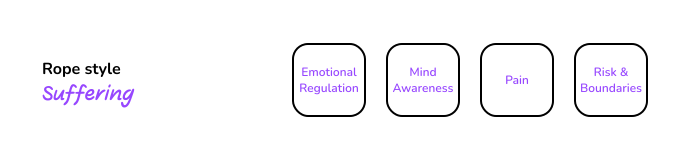
To support this principle further, the concept brings in the concept of rope styles. A style is a way of bottoming that emphasizes 1-4 skills over others. It doesn’t mean the others are ignored, as some are extremely valuable regardless (i.e. Risks & Boundaries), just that every person has different intents, desires, and bodies, and thus they will resonate on some combinations more than others.
This is analogous to the corresponding idea of rope styles for tying, that generally covers a set of different ideas, approaches, and skills for riggers. It’s important we have a matching one for bottoming.
Styles also aren’t fixed in time: one person might have just one style they are interested in, or more than one. Or different ones with different partners. The idea is again not to box people in, but to open up for exploration and inquiry. A simple reflection in a group on “what are the 1-4 skills that make your style” and then sharing can bring up a powerful and interesting discussion.
Let’s see some examples.
Suffering style
- Emotional Regulation
- Mind Awareness
- Pain
- Risks & Boundaries
This is a style we can consider based on suffering in the combined physical and emotional sense, that’s why it puts so much importance in emotional regulation and mind awareness. In some way, this is the set of skills that could be identified for ‘semenawa’ rope.
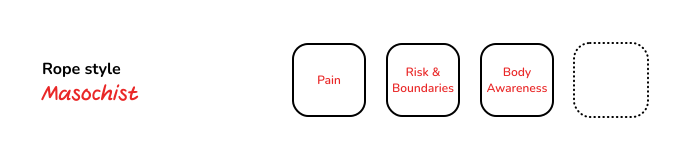
Masochist style
- Pain
- Risks & Boundaries
- Body Awareness
- ·
The differentiator here for masochistic style would be an individual that is more focused on the physical side of rope and related pain. This kind of style would also likely include non-rope types of physical pain.
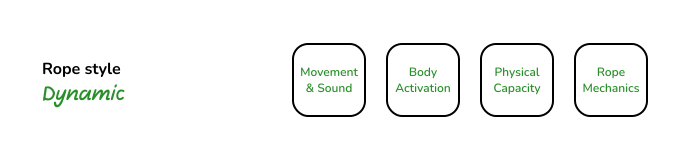
Dynamic style
- Movement & Sound
- Body Activation
- Physical Capacity
- Rope Mechanics
Let’s move! This is a kind of style where both the rigger and the bottom move together, creating scenes that get inspiration from dance. This can be done more often standing, or using single suspension points while leaving the bottom to move and interact with the rigger during the scenes, or part of the scene.
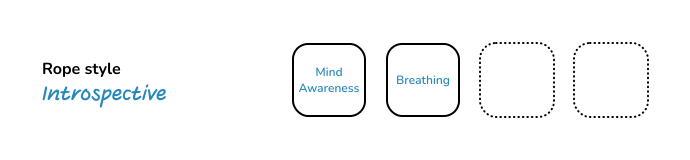
Introspective style
- Mind Awareness
- Breathing
- ·
- ·
In this style people practice sinking into themselves and reach meditative states of mind. While all rope can have elements of meditation, this specifically is seeing calm and quiet. While it can also include of course pain and other elements, they are secondary to the focus on the mind.
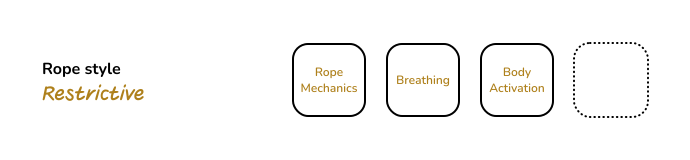
Restrictive style
- Rope Mechanics
- Breathing
- Body Activation
- ·
These scenes are focused on restriction of movement and breathing. They often use more rope to create a strong sense of immobility and thus a related powerlessness.
These are just examples: you might read them and resonate, or read them and go “hell no”. That’s great. There are as many styles as people, and even each person might desire different styles at different times.
What’s your rope style
When starting in a rope journey, it’s common to just follow the other people around us: from learning the style of the local educators, to discussions with other bottoms and riggers. These discussions are especially important, and we can use the compass to help understand each other better.
A good starting point is to take a moment, look at the compass diagram, and write down your own style — or styles. Don’t overthink, just make a first draft and see what comes up. There’s always time to scrap and do it again: it’s just four boxes.
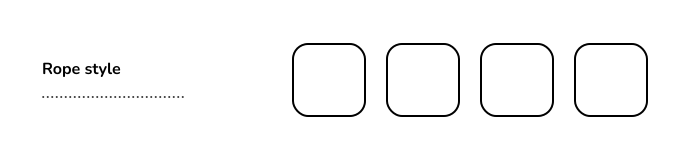
Note that while it’s a general idea to go from the most to least important skill, that’s not a strict requirement: in some cases there’s more than one you consider equally important. Take that more as a way to ask “what’s important”, and less about actually having to pick a strict order if it doesn’t feel right.
How to use the compass
The compass for bottoms
If you are new in your bottoming journey, then you can use this compass as a guide: what each of these skills mean? How can you learn more about it? Can you find teachers that cover that area? Which one interests you more?
If you are already on your bottoming journey, then you can use it to guide you more clearly in what you might not have tried yet, or in what you might want to explore more in-depth.
This can also be used to assess educators by mapping their practice and their classes to the skills, and see if that corresponds to the skills we are interested in learning. For example two classes with similar names taught by different people might focus on very different sets of skills. If in doubt, you can always contact them and ask what the class is about sending them the compass too as a guide.
The compass for teachers
This compass isn’t meant to replace existing rope teachings and the excellent work that a lot of educators are already doing. It’s also not meant to suggest that this is the right way and right language to use, and any other is wrong. This compass is instead meant to create a way for existing educators to reflect and — hopefully — support their work.
At its most basic, you can take the structure and skills as they are, and use it to highlight your own classes. For instance, you can annotate in the class description the skills from the compass that will be covered. This will help a better match of the students for the class, which brings benefit to both teacher and students.
You can also extend the compass: if you specialise in a skill that you think it’s important to exist at the same level as the others, you can place it in the right quadrant to help students understand better the importance of this teaching. You can follow the same model above to define the skill, or use your own.
Taking one skill and adding further detail can also be a strategy that can help with clarity if your teachings have important distinctions within a skill. For example you can expand “Breathing” in three sub-types “Processing”, “Restricting”, “Connecting”, each with its own definition.
Finally, you can also adjust the compass if you really think that the current placement of skills isn’t correct. While this is probably a more extreme position and I hope it’s not necessary, I can assume some people disagree and would rather change things up. In this case it’s important to make clear it’s presented as a variation, and what the changes are.
In short, if you are an educator, feel free to use it and share these resources.
Here’s also a blank template you can use, to then position the new skills you are introducing and teaching in your classes and practice:
How this was made
I’ve started with a survey on Instagram in 2024 asking about things that people feel they need to know as rope bottoms, with a focus on skills. This was to cast a wide net across different people and perspectives, at different skill levels. It also gave me people to have conversations with.
I integrated this perspective by researching existing writings on the topic, both via articles published online and a few books. Some of the references used were:
- “Somatics for Rope Bottoms” by Natasha NawaTaNeko
- “Better Bondage for Every Body” by Evie Vane
- “A Guide for Rope Bottoms & Bondage Models” by Clover
I then combined the notes I took from both and tried to identify key skills that are needed. This process took a long time, many iterations, and many conversations every time I felt stuck or in doubt, and led to a first draft of key skills and how to represent them to make them more visual.

Once the first draft was completed, I then started reaching out to expert bottoms and educators that have done bottoming classes to ask their perspective: is this clear? Does it cover the key skills needed? Anything that could be misunderstood?
While this work has reached a point that is “good enough” to be useful, the refinement work is still open, and it can evolve in the future.
Credits
Major thanks to Anna Bones for the conversations and classes that led me to start this work, and for being supportive as this work was taking shape.
Thanks to all the people I interviewed and had in-depth conversations on the topic: Aventurine, Kissiae, Noctuelle, Mel Kitenga, MJ, Saara Rei, Kitty Rea.
Thanks also to the Clickin’ Bitches UK group that has been a constant source of reflection and helped review many of the ideas in this writing. Thanks especially to Hollie Berry, Mira, Draakje, Miss Dion, Kameko Epitaph, Stephani Lythe, for contributing to the review.